Teaching Whole-Body Dexterity with a Wearable Contact Interface
1Stanford University2Amazon FAR3Carnegie Mellon University†Equal Advising
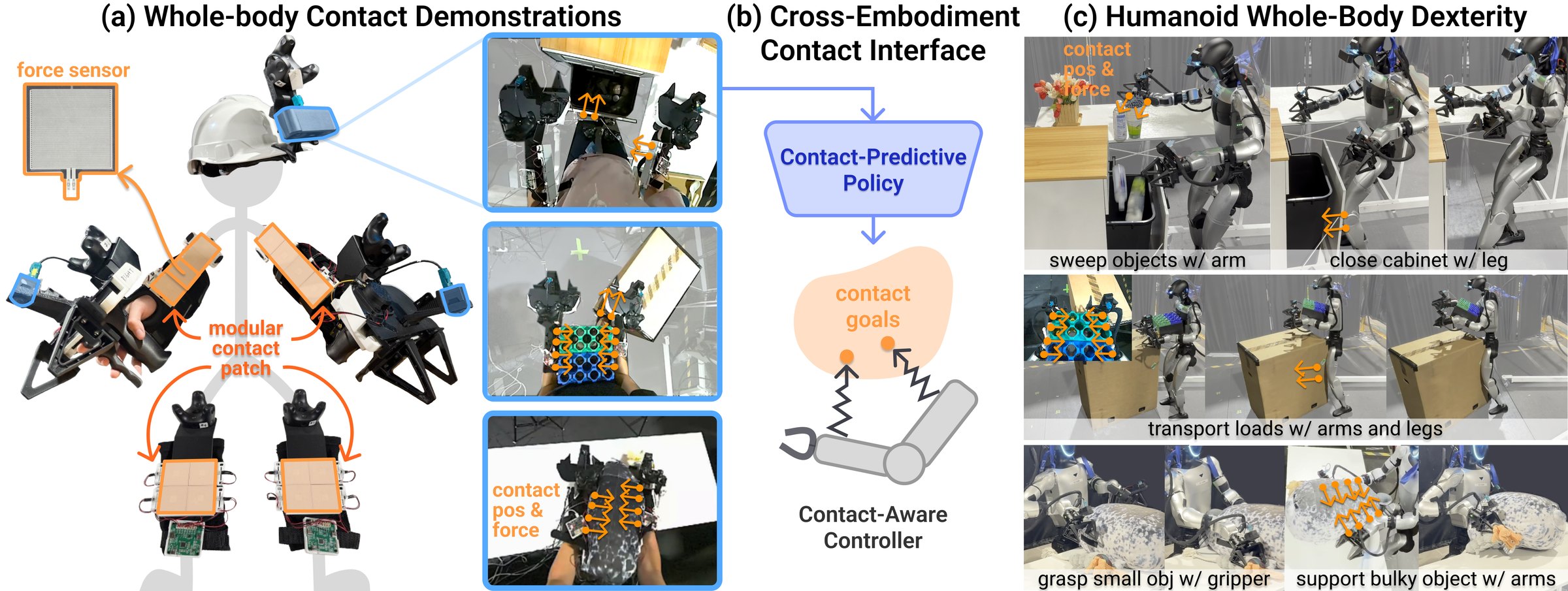
Humanoid robots have many degrees of freedom and contact surfaces, yet most loco-manipulation research restricts manipulation to the hands and avoids other body contacts with the environment. To extend manipulation beyond the hands, we present PanTact, a system that learns humanoid whole-body dexterity, the capability to manipulate with any suitable body surface, directly from robot-free human demonstrations. Our key idea is to use contact as manipulation-centric information that transfers across embodiments. Contact locations and timing specify the interactions needed to accomplish a task, while the robot chooses how to coordinate its body to realize them within its own physical constraints. Specifically, PanTact captures, learns, and executes whole-body contact via: 1) a wearable, robot-free data collection interface that augments egocentric vision and bimanual UMI grippers with whole-body modular contact patches to record body contact locations and states; 2) a visuomotor policy that mitigates the egocentric observation gap and predicts whole-body contact goals; and 3) contact-aware whole-body control formulations that realize active contact goals using suitable robot surfaces. We deploy PanTact on a Unitree G1 humanoid without additional body contact sensors, demonstrating whole-body dexterity involving body support, pushing, sweeping, and load-sharing.
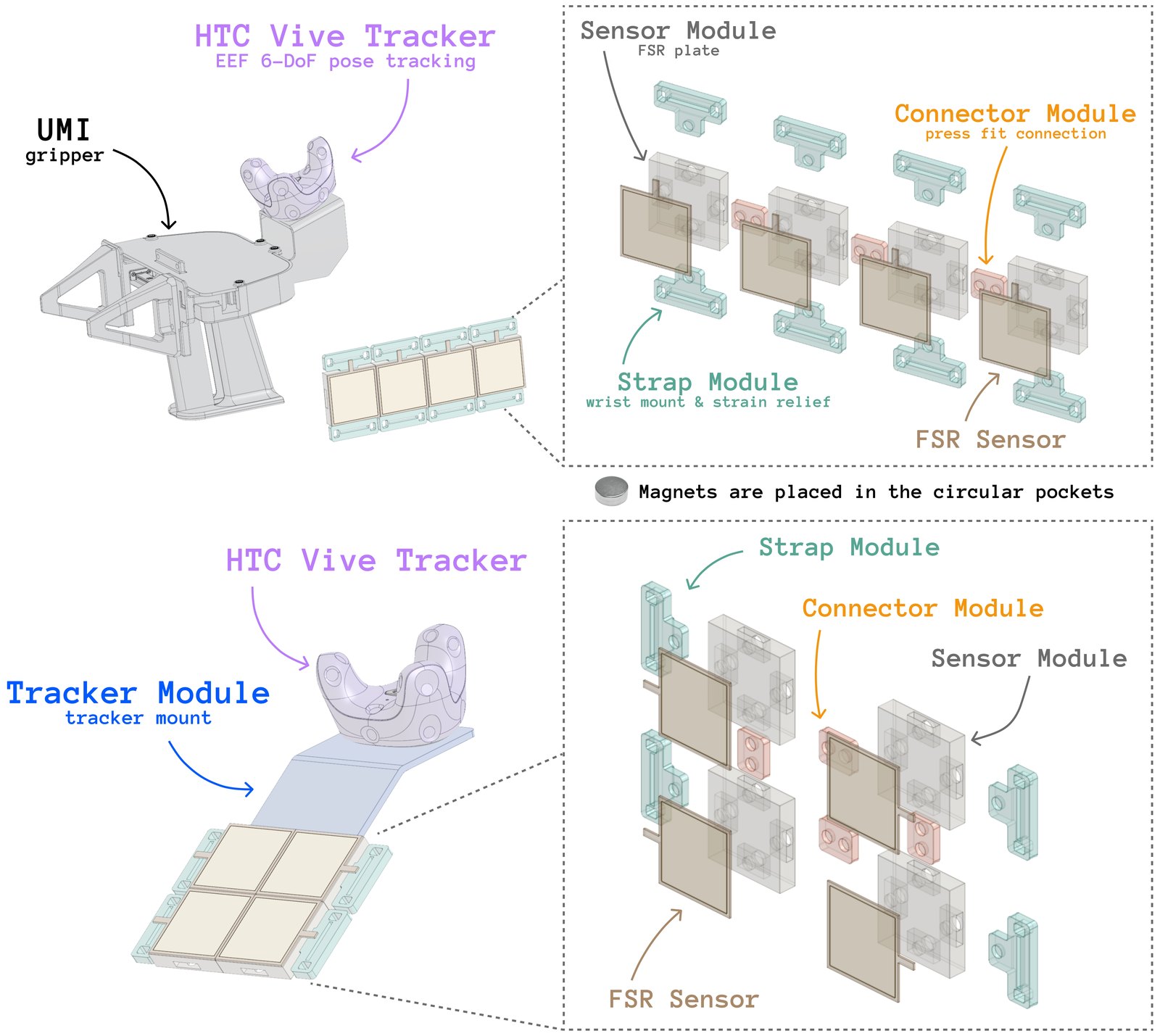
Egocentric-augmented bimanual UMI grippers plus modular contact patches on the forearms and knees record where, when, and how hard the demonstrator's body contacts the environment.
Robot-free demonstration. Head and wrist camera views recorded alongside live readings from the forearm and knee contact patches, captured in sync while the demonstrator performs the task.
A contact-predictive policy maps embodiment-agnostic observations to EEF trajectories and whole-body contact goals.
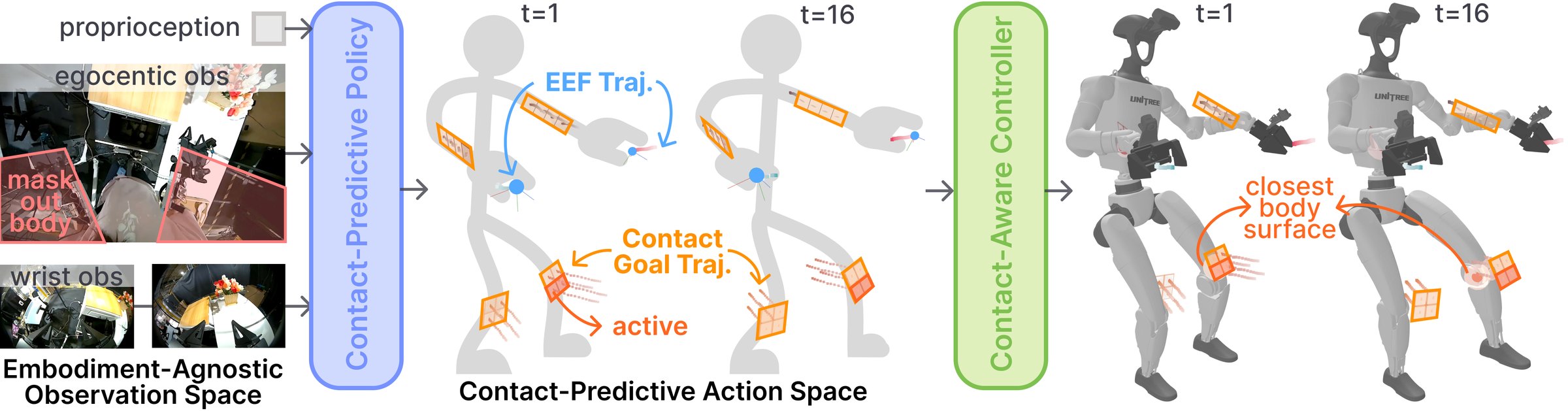
The controller realizes active contact goals with any suitable robot surface, rather than assigning each contact to a fixed link.
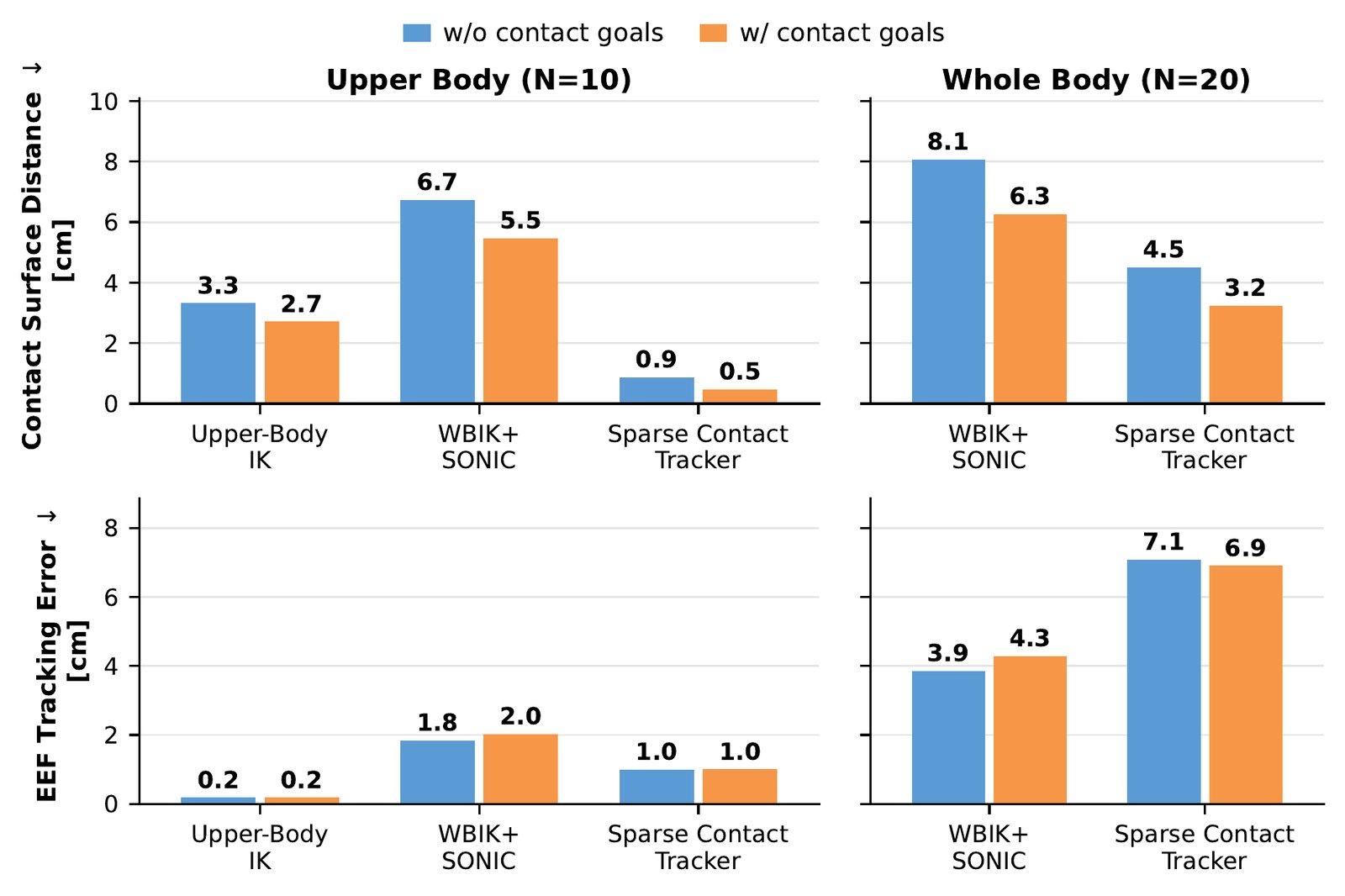
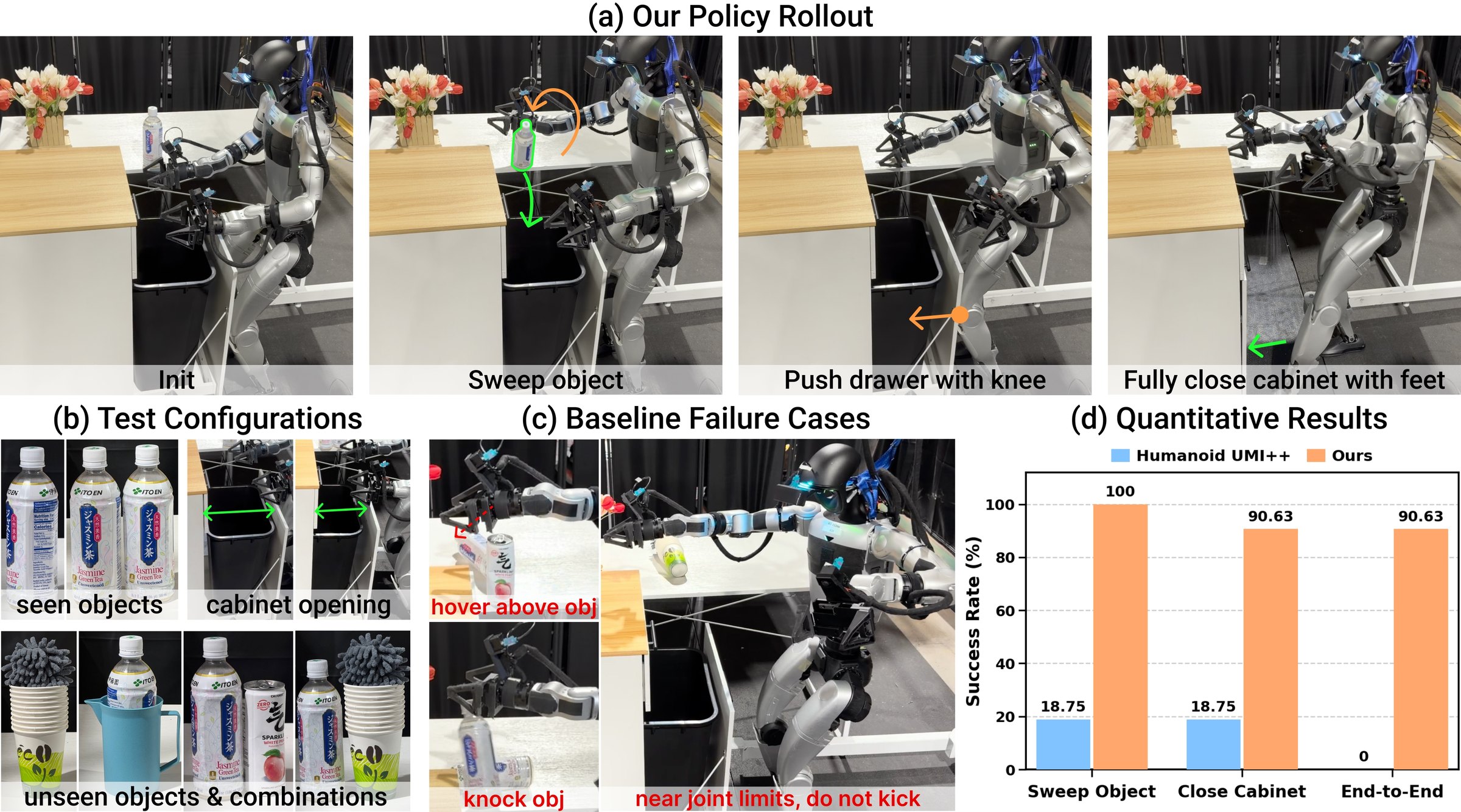
The robot sweeps tall objects from a counter into an open bin in a single stroke, then uses a lower-body surface to push the cabinet closed. Ours (WBIK + SONIC) reaches 90.63% end-to-end success; Humanoid UMI++ 0%.
Ours · WBIK + SONICThird-person view (left) and synchronized robot egocentric view (right)
Seen object, different layout
Unseen object
Two seen objects
Two unseen objects
One object
Two objects
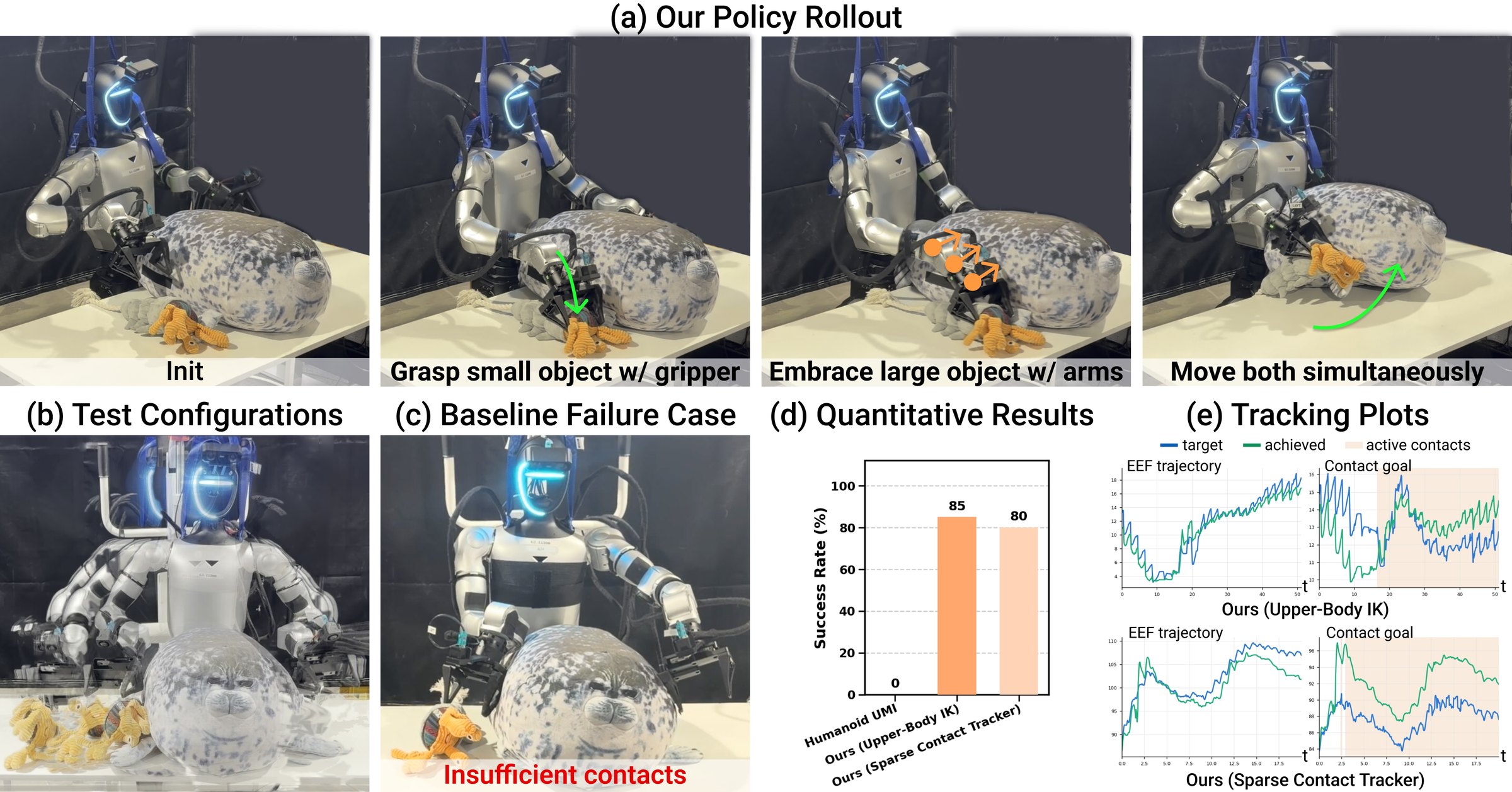
The robot grasps a small object with the gripper, then embraces a bulky object with its arms and moves both simultaneously. Ours (Upper-Body IK) reaches 85% success; Humanoid UMI 0%.
Ours · Upper-Body IKRollout 1
Rollout 2
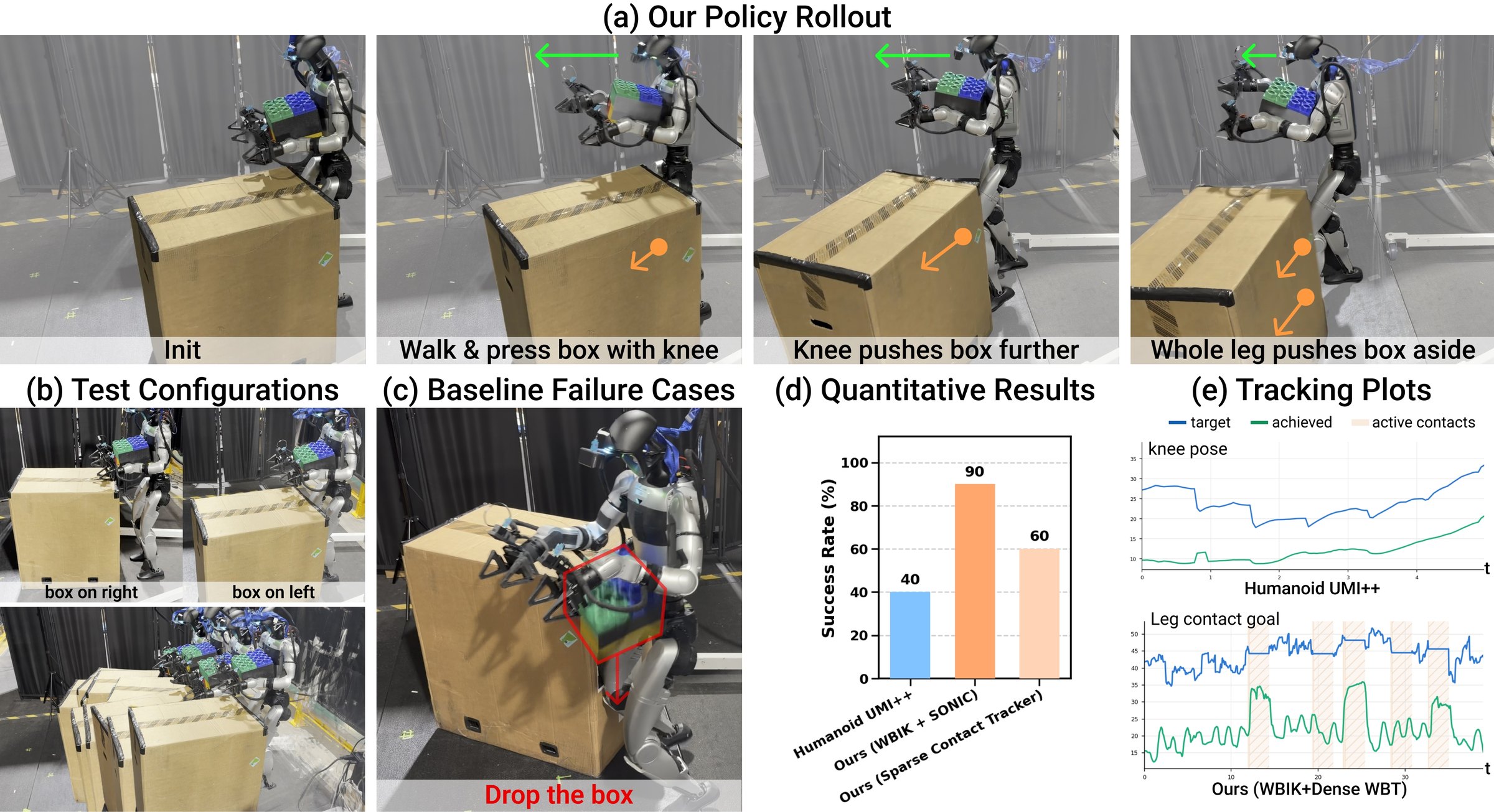
The robot carries a box in both arms, walks towards a larger box on the floor, and pushes it with its shins and knees. Ours (WBIK + SONIC) reaches 90% success; Humanoid UMI++ 40%.
Ours · WBIK + SONICRollout 1
Rollout 2 · box on right
@misc{pantact,
  author       = {Xiaomeng Xu and Han Zhang and Zhian Ruan and Xiaofeng Guo
                  and Jinkun Cao and Ruihan Yang and Carmelo Sferrazza
                  and Shuran Song and Guanya Shi},
  title        = {PanTact: Teaching Whole-Body Dexterity with a Wearable Contact Interface},
  howpublished = {arXiv preprint},
  year         = {2026},
}